


Grab the Charcoal and Start
Interview with Quinten Torp
When the hands of Quinten Torp (aka Geert Mullens, °1960, Genk) aren’t holding a brush or working with charcoal, chances are they’re gripping the handlebars of a bicycle. He even manages to combine his two favourite pursuits — painting and cycling — on adventurous painting bike trips. In his most recent project, TURNERoundITALIA, he sets off for Italy equipped with paint, brushes, and his vintage bicycle (which, for longer distances, hitches a ride on the roof of a vintage car). To mark the 250th anniversary of J.M.W. Turner’s birth, he follows the English Romantic painter’s path through Italy — by bike. Back in 1819, Turner himself was captivated by the light, colours, and atmosphere of the Italian landscape.
Although Quinten Torp paints en plein air during his cycling trips, and frequently chooses mountains or trees as his subject, he doesn’t define himself as a landscape painter. The landscape, he explains, is not the subject but the starting point. Nor is it his intention to treat Turner’s sketchbooks as a kind of travel guide to retrace the exact spots where Turner once painted. “When I jump on my bike, I don’t know in advance where I’m going. I just start riding, and at some point, I stop somewhere. I can’t say why. It doesn’t have to be a picturesque place. Sometimes it’s just practical, for example: I pick a spot where no one can see me. What I’m trying to express in the image is a certain atmosphere, emotion, or experience. Looking at a single landscape in front of me, I could make a thousand paintings, so to speak. The image becomes an expression of something inside myself.”
Allowing the Unexpected
For Quinten Torp, everything starts naturally with the physical gesture: grab the brush (or charcoal) and start. “People often ask me: ‘Where do you get your inspiration from?’ But for me, painting isn’t something that you need inspiration for first. I take the brush in my hand, and I start. Usually with only a vague idea of where I want to go. If you have to wait for inspiration, well, you might just keep waiting.”
As he paints, deeper layers emerge. “Later on, I see a coherence, an underlying reason that I didn’t know at the time. But first there is the doing, the physical contact with the brush, and accepting that the paint doesn’t always behave the way you want it to, that unexpected things can happen. That’s precisely where the work comes to life for me. Even mistakes or imperfections can find their place.”
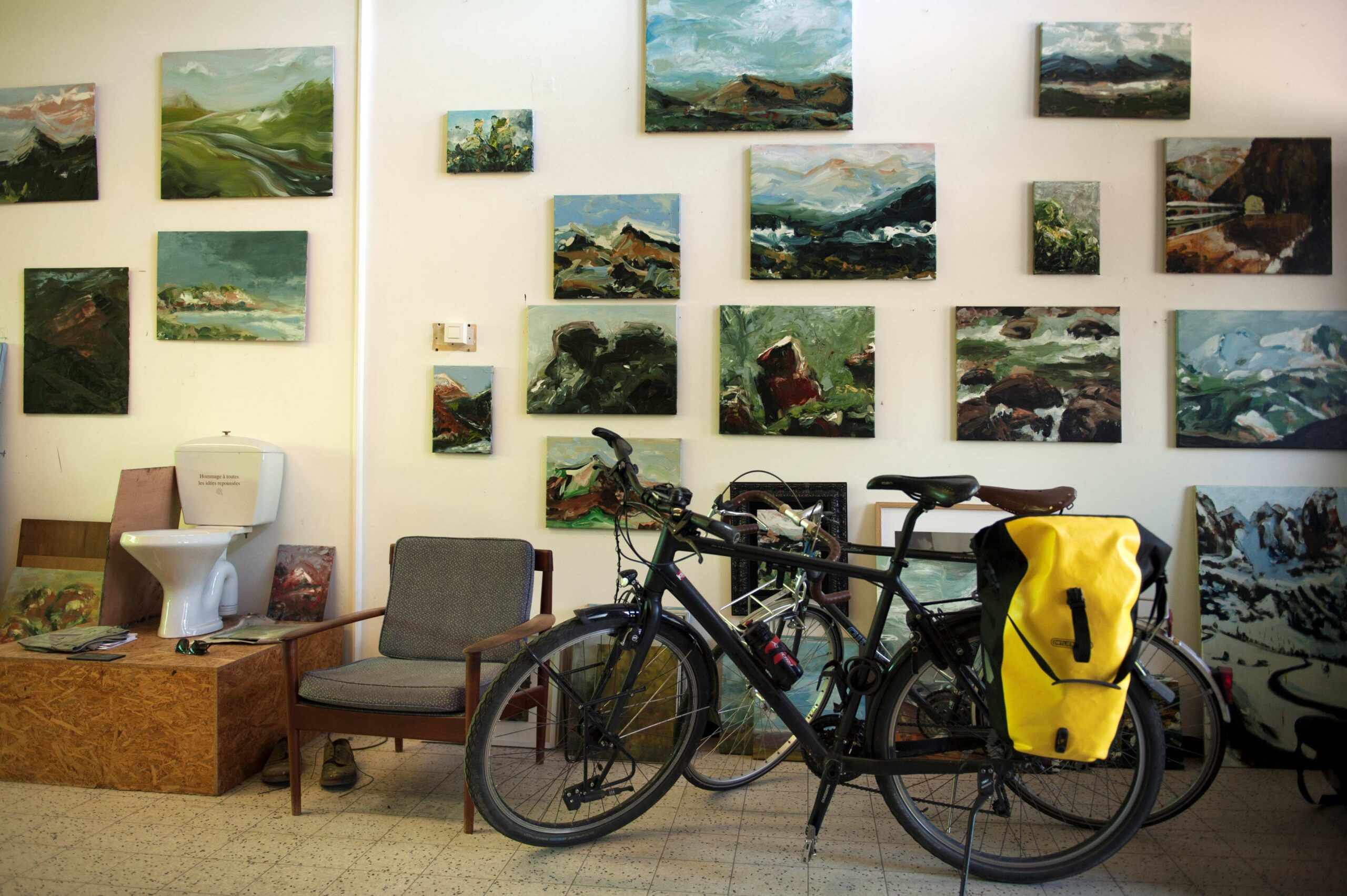
This was already the case in earlier projects like the Il Cambio series (a reference to bicycle gears but also to changes in a person’s life). On this cycling trip through Italian mountain landscapes, he brought loose canvases so he wouldn’t have to lug around an easel. He hadn’t really considered beforehand that the natural surfaces he painted on (rocks, soil) would play a role in the creation. “I worked with acrylic because it dries quickly. Sometimes the heavily diluted paint would run. It found its way through the unevenness, small channels formed. That was actually fascinating: something practical giving a different twist to your work. I both allowed and didn’t allow it. That made the works.
Performance on the Road
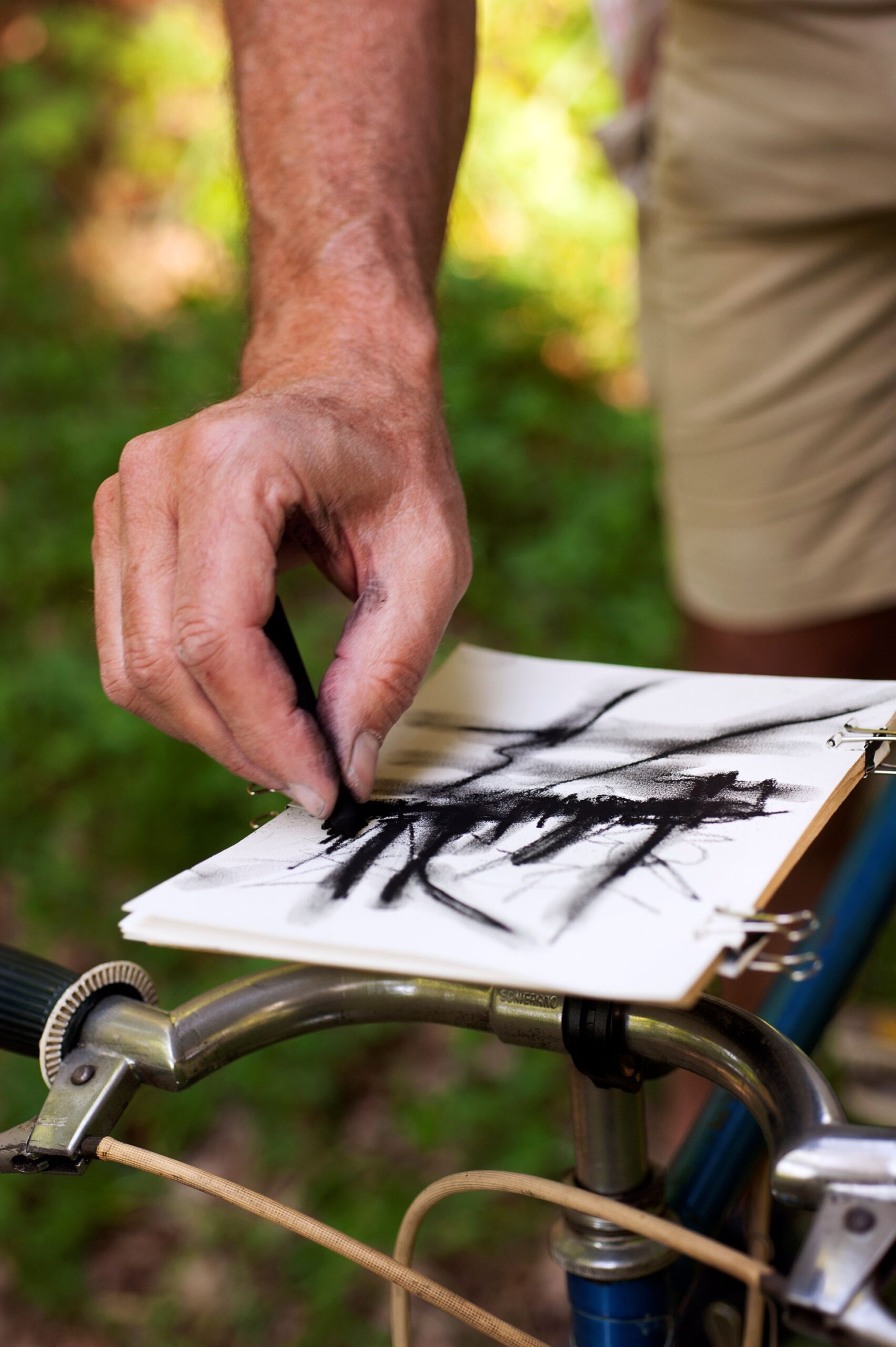
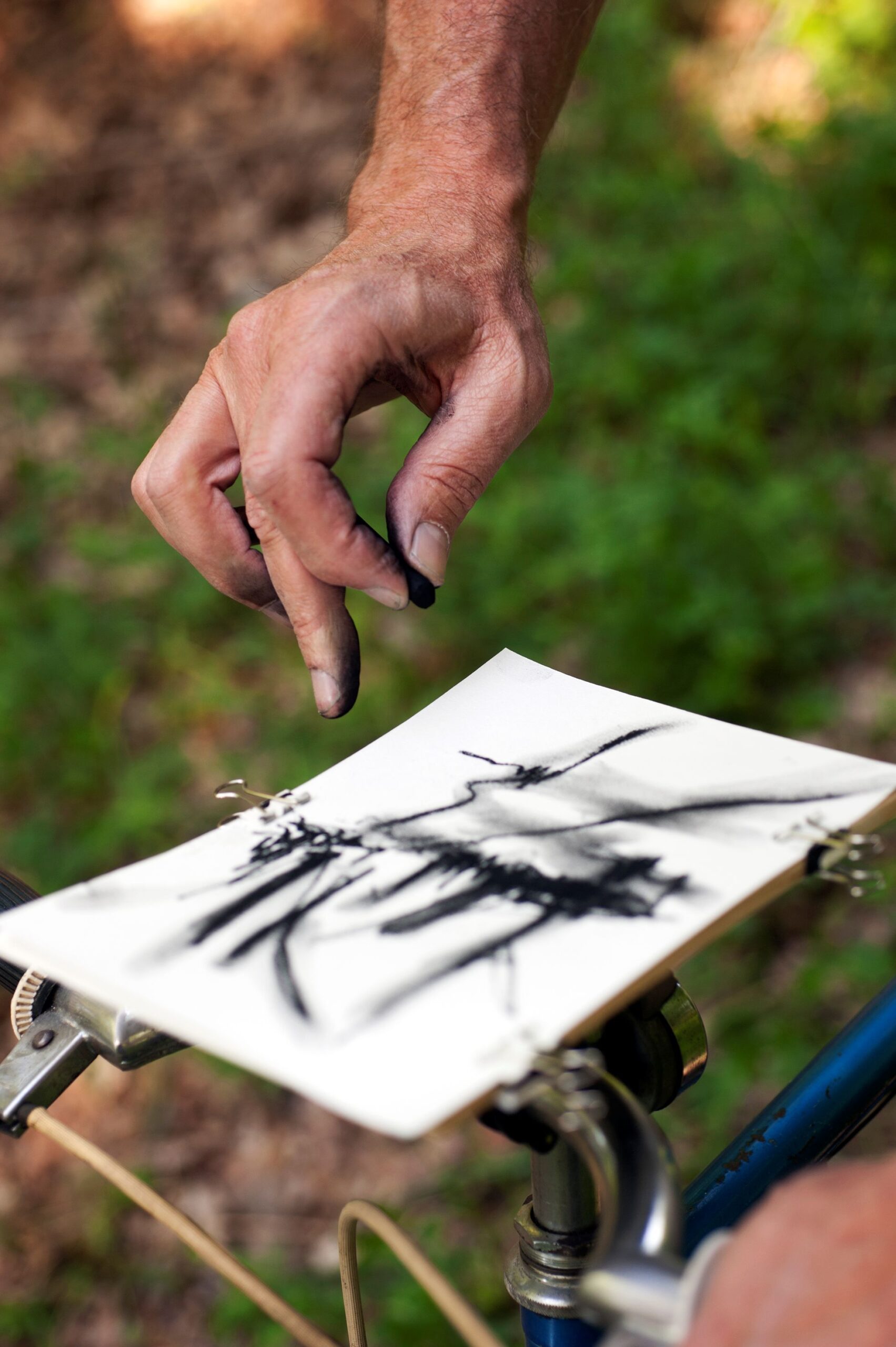
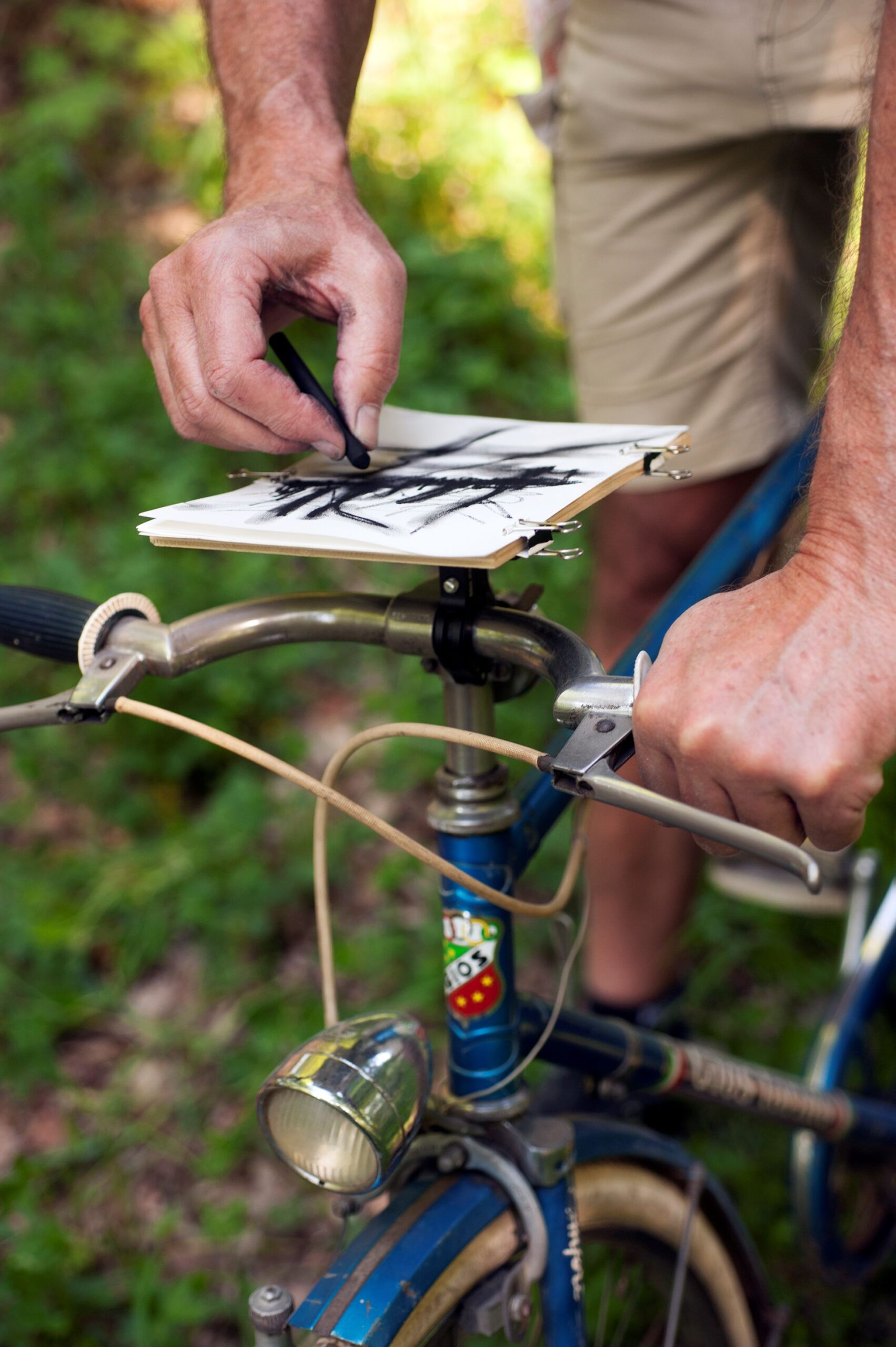
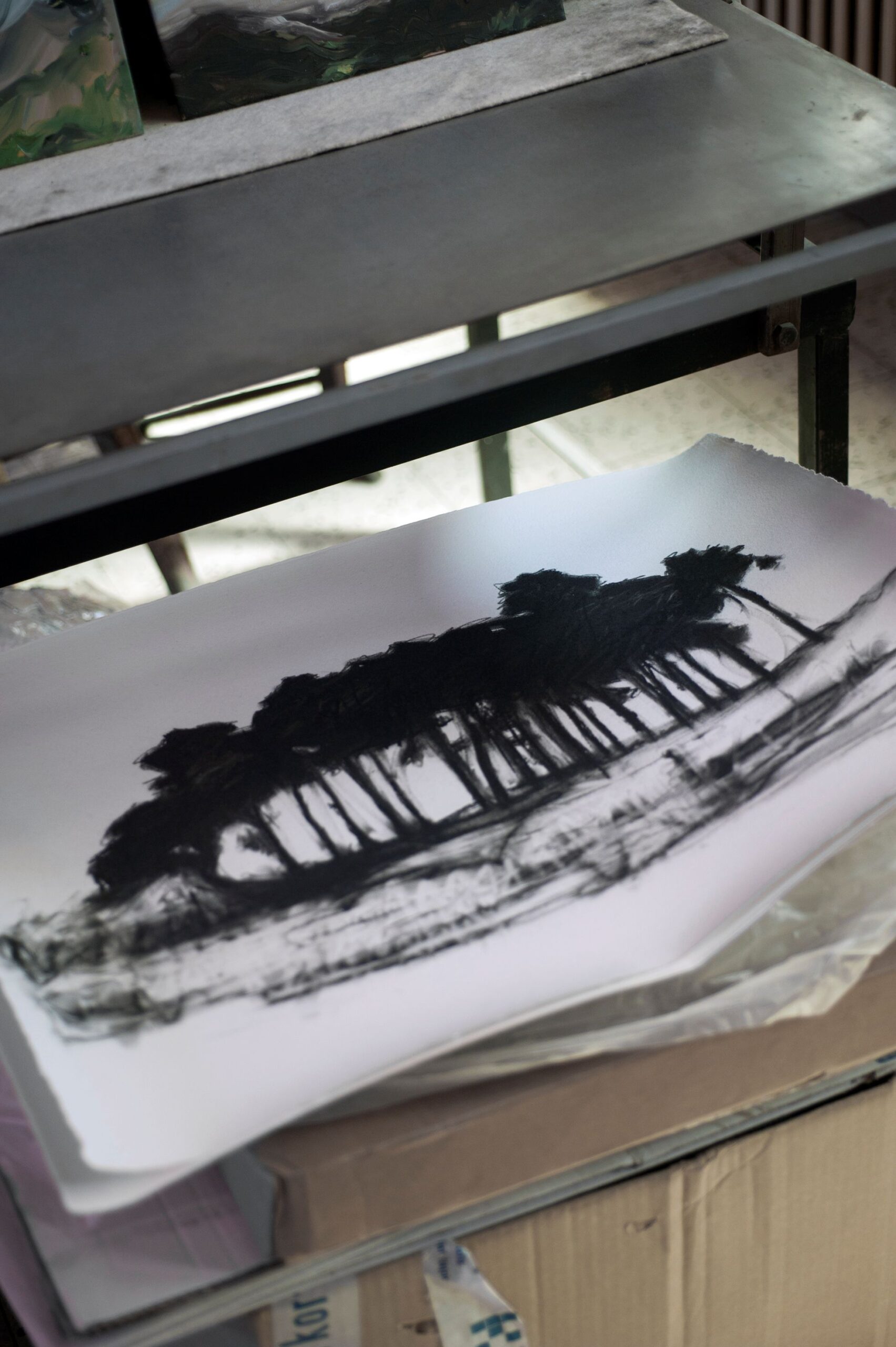
In his recent Condorino series, he opens up even more radically to the uncontrollable — “the things you don’t have in your hands.” He makes sketches on the go on a Condorino, a type of old city bike with handlebars shaped like condor wings – perfect for mounting a sketchboard. Sometimes he draws while cycling, sometimes during short stops. He works with dry materials like charcoal or extremely soft pencils that produce deep black lines. The process is fast, and the simplicity and power of the lines capturing the landscape are palpable: “The line you drew a few meters back is already irrelevant because the landscape keeps changing as you cycle. But I also stop regularly. Being on the road always plays a role. That’s how very primal drawings arise, almost scribbles, that try to capture something essential.”
This way of drawing is related to how he paints: physical, intuitive, and open to what happens along the way. Sometimes he even draws blind. Then drawing becomes a kind of performance, an act in which the landscape is again just a trigger. The image still recalls it, but it becomes something in itself.
Not Too Precise
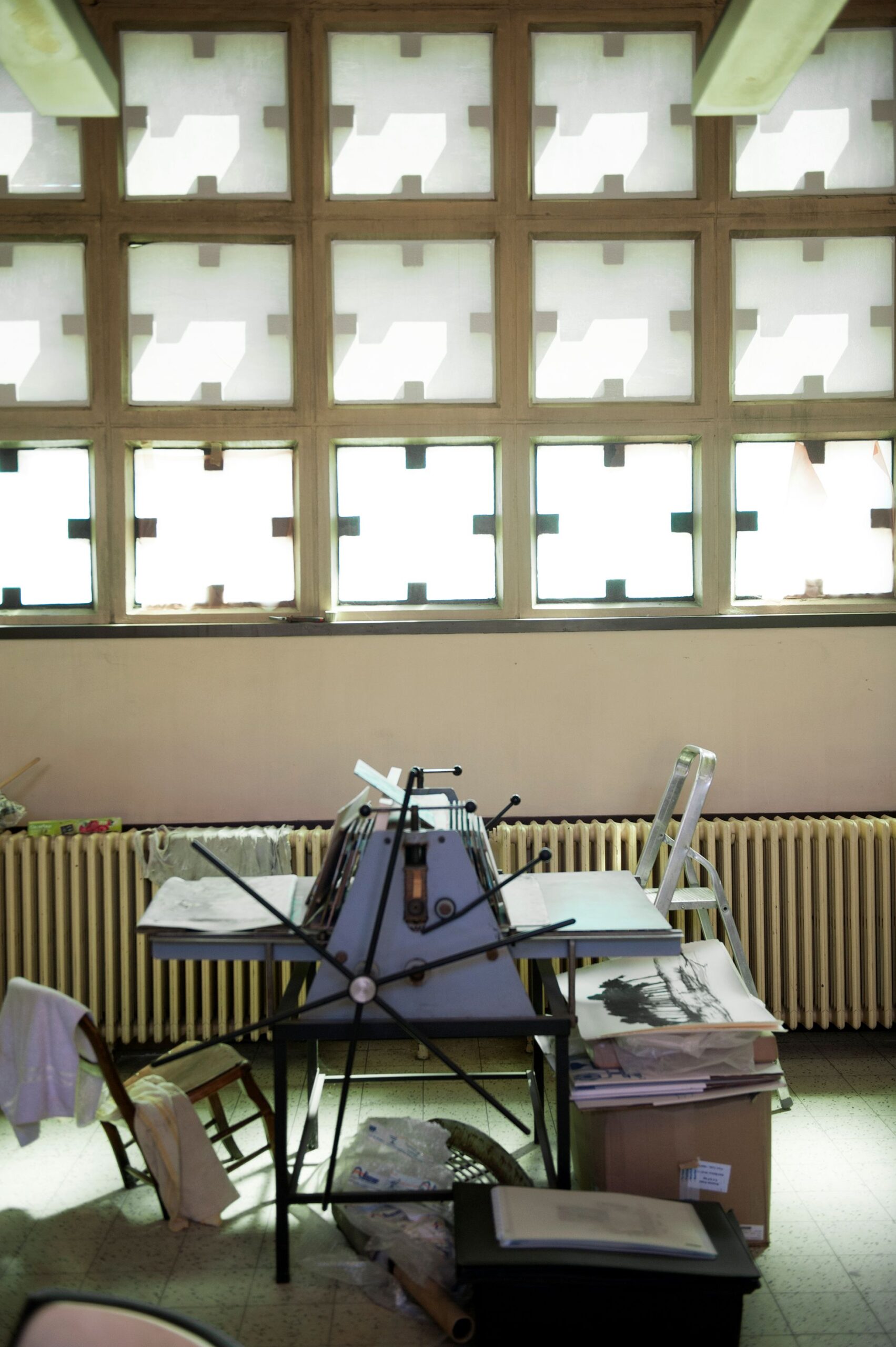
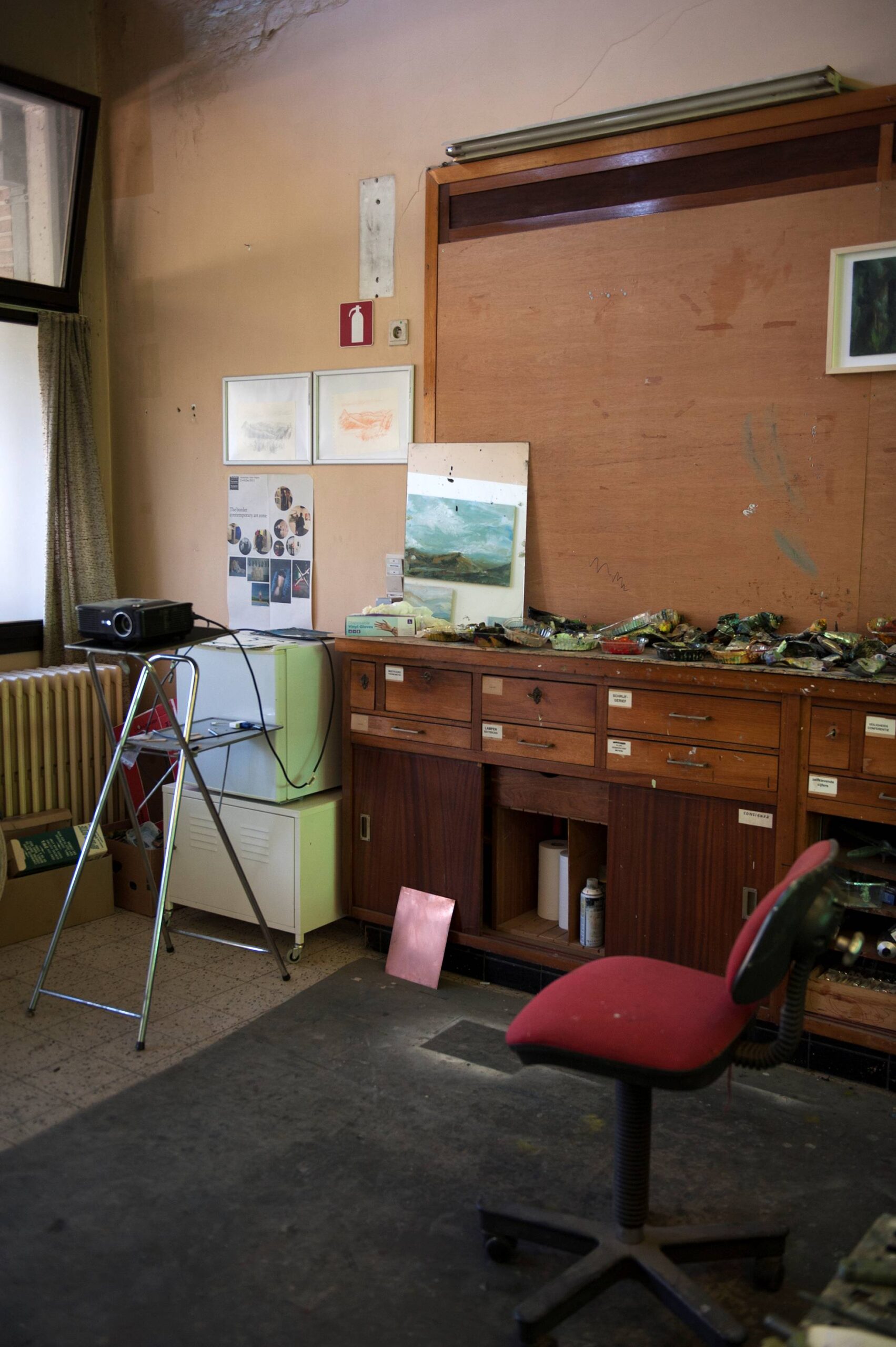
When he’s not on the road, he works in his studio at the Zolder train station (Heusden-Zolder). That’s where we meet to talk about hands in art. He can’t give examples of hands in his work. “I’m not really focused on that in my work,” he says. Yet he recognizes the importance of hands as obvious. “My hands are very precious. I think that’s true for everyone. You only realize how helpless you are when something is wrong with your hand. The same goes for legs or other limbs, but you need your hands to create: a text, music, a painting, a house. With your voice you can sing — that’s creating too — but with your hands, you make something that lasts. Hands are an extension of your mind to create something.”
He always paints wearing surgical gloves. “Because I get so messy. (Laughs) I didn’t wear them in the past, but I always had to use turpentine to clean my hands. That didn’t seem very healthy.” Now that he’s used to it, the gloves don’t bother him while working. He doesn’t work in detail and applies paint generously. “Some people don’t recognize the figurative in my work; they just see blobs of paint,” he sometimes observes. Still, his work is never completely abstract. “I navigate a line between when paint becomes image and when paint remains just paint,” he explains. “It mustn’t be too precise. It has to stay creamy.”
He is clearly not the type of artist who wants to keep tight control or hold the viewer’s hand. With his visual art, he strives for “a kind of one-on-one experience,” like with music: “You listen to the same piece as someone else, but your thoughts wander to what you yourself have experienced. That’s what I want with my work too: that people follow me in what I make, but at the same time find their own ideas, memories, or feelings reflected in it.”
Your favourite hands in life?
Quinten Torp: “Definitely my own hands. And the hands of a loved one — they’re very important too: you can hold them, they’re the closest to you.”
Your favourite hands in art?
Quinten Torp: “An art history teacher once pointed out the hands in Caravaggio’s work to me (1). If you look closely, you can see dirt under the fingernails. He used ordinary people from the streets as models. I found that fascinating. I really loved those dirty nail edges. Michaël Borremans once painted a red and a green hand — a brilliant piece. Others have copied it since, but the original really stayed with me, also because of the colours. I’m not necessarily a huge Borremans fan, but that I thought was truly good.”
Your favourite quote about hands?
Quinten Torp: “I immediately thought of a Dutch saying I like to reverse: ‘Better one bird in the hand than ten in the air.’ But I turn it around – for me, it’s better to let ten birds fly. That sums up how I see life: I want to let things go, let people fly. I want to give everyone the space to do what they love and do well – not to hold them back.”
Your favourite hand gesture?
Quinten Torp: “This one here.” (He raises his little finger and index finger.) “It’s associated with rock music – you see it at festivals. For me, it has something combative about it. Originally, it meant something else: ‘cornuto’ (literally ‘horn-bearer’ in Italian), but over time it’s been distorted and has taken on a new meaning. It’s an expressive sign, positive, maybe a bit of a cliché, but I prefer it to a fist. A fist feels too aggressive.”
What do you like doing most with your hands?
Quinten Torp: “Doodling. Or painting. Or holding a bicycle handlebar. There are so many things.”
Something you have painted directly with your hands or fingers?
Quinten Torp: “Nothing I painted. But I once sculpted a small figure out of wax with my hands. On top, I modelled a little head. It was a lovely piece, and it even held an imprint of my hand. But it broke.”
Worst thing that ever happened to your hands?
Quinten Torp: “I once had a deep cut on my finger from a bread knife. That was the worst.”
The characteristics of your handwriting?
Quinten Torp: “Terribly ugly and illegible. Impatient, too – I rarely write by hand anymore, and when you don’t do it often, you stop taking the time for it. In the digital world, handwriting doesn’t really count. But when I write a title on paper, I do try to make it look decent.
My signature is ‘QT’, intertwined, like a little icon. I don’t care much for my actual signature. ‘QT’ comes from Quinten Torp – a name I started using back when I had my own gallery. I found it difficult to work under my real name, Geert Mullens, as both gallerist and artist.
My mother’s surname was Quintens. I got the artistic side from her. She passed away when I was eleven. In those days, it was something people didn’t talk about. My artist name is a tribute to her. And ‘Quinten Torp’ just sounds good. I also made a series around the idea of the ‘Torpedo’ – something that takes you by surprise but still has a strong impact. A positive one, I mean – a feeling that suddenly hits you. What I like is that the name allowed me to speak about myself in the third person. In the beginning, I still felt uncertain, and that helped. The name stuck.”
If you could switch your hands with those of another artist, who would it be?
Quinten Torp: “I won’t name anyone in particular, but I’d like to switch with the hands of a virtuoso pianist. That way, I could start playing immediately, without years of practice. I’m a little jealous of musicians—they can express emotions so directly. I wanted to try it myself, but I lack the discipline. My brother is a good musician. It’s wonderful to watch musicians at work—the interaction, the teamwork. As a painter, you live quite a lonely life. I always paint alone. I don’t even cycle in groups. Collaborating seems wonderful, but at the same time, I seek isolation myself. It’s a mixed feeling.”
Which living artists would you like to touch the hand of?
Quinten Torp: “Francis Alÿs. He’s a man of great integrity. I find his work sublime. Holding his hand wouldn’t feel wrong to me.”
Which heroes or heroines from art history do you spontaneously clap your hands for?
Quinten Torp: “Goya (2), definitely. I first came across his etchings during my printmaking studies. I copied them to better understand his hatching and use of aquatint. When you copy something, you start looking at it in a completely different way. I even based my graduation project on his work. He’s one of the founders of modern art. The expressiveness of his black paintings still impresses me, and the fact that he could combine that with being a court painter fascinates me too. I also think Gustave Courbet was a brilliant painter. He really made a difference. And as a Belgian and a painter, I have to mention Luc Tuymans as well. Especially in the 1990s, he was groundbreaking for painting, not just here, but internationally too. And of course, there are many more.”
Something you don’t want to get your hands dirty on as an artist?
Quinten Torp: “Taking commissions or making adjustments to my work — I don’t do that. When people tell me they’d like a certain painting in a different size or version, it really makes me cringe. I get that some artists are okay with it, but that’s not the kind of art I want to make. My paintings are mine, and I want to keep it that way — I can’t make compromises on that. Of course, people can buy the work, but then they’re buying a piece of me, so to speak.”
Last time you cycled with no hands?
Quinten Torp: “Last Sunday. On my regular racing bike as a cycling enthusiast.”
Do you ever feel a bit heavy-handed* – in spirit, that is?
(*In the original question in Dutch, “zwaar op de hand” means being a bit melancholic – not just clumsy.)
Quinten Torp: “Yes. (Laughs.) No comment.”
Something for which you wish you had a better manual?
Quinten Torp: “Sometimes I wish there were a better manual for life. But no one has one – that’s the point. You have to write it yourself. That’s beautiful, but also hard. In the past, people had something like a manual through religion, with fairly clear guidelines about good and evil. Now you have to figure that out for yourself. It’s more freedom, but it also makes things more complicated. You can look at everything from two sides.”
Do you have a final comment up your sleeve?
Quinten Torp: “Maybe something about gloves – we haven’t touched on that yet. Gloves protect you from the cold, from rough work, from cuts. Or you can box with them – they protect your hands there too. A goalkeeper’s gloves make the hands bigger, they’re like extensions. That idea of a shell or an extension really interests me. In a way, hands themselves are extensions of language. When people talk on the phone, their hands move too. You can tell by their gestures what tone they’re speaking in. I notice I’m using my hands as I speak now.”